
“Our Way of Life”
He meant every word

Thanks for reading Anti-Capitalist Musings. It is a small operation, and I hope it offers something worth your time. There will be no premium subscriber content here: everything published will remain free to read. If you value these pieces and want to support the writing, buying me a coffee helps fund media subscriptions and the books that keep the analysis grounded. Every contribution, however modest, is genuinely appreciated.
On Tuesday, Assistant US Attorney Bill Essayli stood at a press conference. The federal government, he announced, would “aggressively” pursue anyone who attacks capitalism, “our way of life, our system, which provides the best goods and services to the most people.” He was explaining why Chamel Abdulkarim, a 29-year-old warehouse worker from Ontario, California, faces federal arson charges carrying a potential life sentence.
Doctrine, not rhetoric.
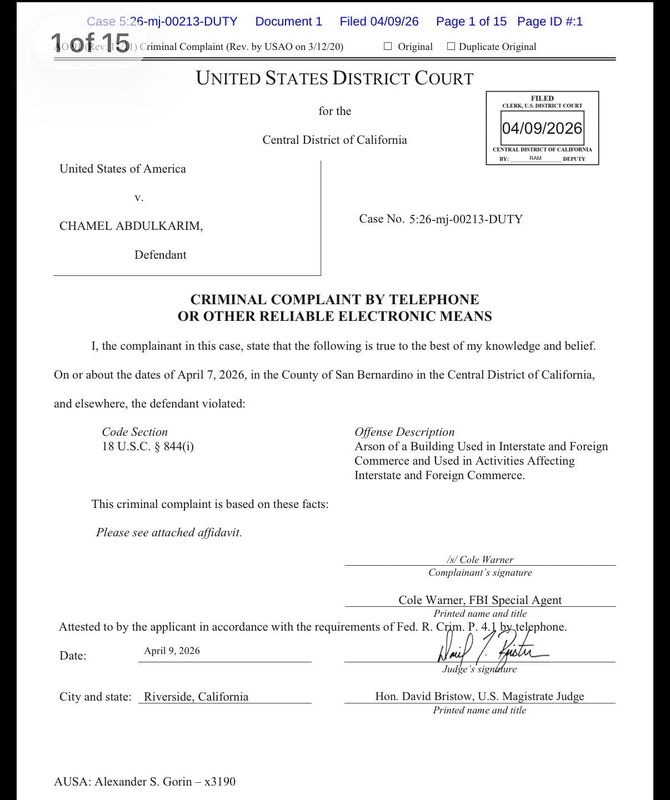
According to the criminal complaint filed April 9th, Abdulkarim set fire to a Kimberly-Clark distribution centre in the early hours of April 7th, filming himself as he did it and posting the video to Instagram. The 1.2 million square foot facility burned to the ground. Estimated damage: $500 million. Eighteen co-workers evacuated safely. Abdulkarim walked two miles down the road, raised his hands when police approached, and said he was confessing. He had already texted his explanation to a co-worker:
What Abdulkarim thought he was doing, and why, is not ambiguous. The question is what the state’s response tells us about the political moment we are actually in.
Start with the employment structure, because it is doing a great deal of work that initial reporting obscured. Abdulkarim did not work for Kimberly-Clark. He worked for NFI Industries, a third-party logistics contractor. Kimberly-Clark’s brand stays clean; NFI carries the labour liability. This two-step is not incidental to the story. It is the story. NFI was sued in 2015 by warehouse workers who argued the company classified them as independent contractors while exercising full employer control over their conditions. A federal judge agreed. NFI settled for $5.75 million. The subcontracting layer exists precisely to create distance between the corporation extracting the value and the workers generating it. When Abdulkarim said shareholders did not pick up a shift, he was describing a real mechanism, not venting.
He was also, the affidavit notes, working six days a week and could not afford his rent.
The San Bernardino County District Attorney, Jason Anderson, told the same press conference that arson was “a real head-scratcher” because the suspect “gets no value out of it.” This is worth sitting with. A man destroys $500 million of corporate property in direct protest at wages too low to live on, and the prosecuting authority cannot locate a motive. The framing assumes that rational action is action in pursuit of individual material gain. A worker who burns down a building rather than accumulate within the system that impoverishes him has, on this reading, simply malfunctioned.
Essayli was sharper, and more honest. He understood perfectly well what Abdulkarim was doing. Which is precisely why the response was not confusion but doctrine.
In September 2025, President Trump signed National Security Presidential Memorandum 7. Ken Klippenstein, who first reported the directive and has since obtained a leaked draft of the upcoming DHS Homeland Threat Assessment, has documented how the memorandum opens with the December 2024 killing of UnitedHealthcare CEO Brian Thompson by Luigi Mangione as its framing example, and identifies “anti-capitalism” as an indicator of domestic terrorism. The leaked DHS draft goes further, introducing a new threat category: “class-based or economic grievances.” Abdulkarim compared himself to Mangione in a phone call recorded by a witness. The federal complaint makes sure to include this. The Joint Terrorism Task Force is handling the case.
Read these elements together and the prosecutorial logic becomes visible. This is not primarily a case about one man burning one building. It is a case about establishing that wage grievance, expressed as direct action against property, is terrorism. The question is not whether Abdulkarim committed arson. He filmed himself doing it and handed officers his wallet. The question being answered here is what political category that act belongs to, and who gets to decide.
Abdulkarim’s politics, such as they were, had no organisational form behind them. No union called this action. No collective demand was attached to it. He texted his co-worker at 1:33 in the morning and walked away alone. Sitting with that image long enough, you recognise something specific: this is what political fury looks like when the organisations that might have caught it and given it direction have been hollowed out over forty years of defeats. The Mangione reference confirms it. Mangione also acted alone, also articulated a coherent class analysis, also had no movement at his back. What both men represent is not an insurgency but an isolation, or what the Trotskyist tradition would call substitutionism, individuals substituting individual action for the collective agency that does not yet exist. That is a real political problem. It is not the problem Essayli was identifying.
Because what NSPM-7 does, and what this prosecution will do, is treat the sentiment as the threat rather than the symptom. Millions of people in the United States work six-day weeks for wages that do not cover rent. The Iran war has pushed fuel costs to levels that make the arithmetic of ordinary life impossible for a significant portion of the workforce. These are the conditions that produced Abdulkarim’s fury, and they will produce more of it, with or without an Instagram account. The security apparatus has decided that the correct response is to build a legal framework that criminalises the political expression of that fury, designating class consciousness itself as a terrorism indicator.
Essayli called capitalism “our way of life.” He meant it as defence. He was also, without intending to, providing the most precise description of what is actually at stake. The system is not being protected from a threat external to it. It is protecting itself from the people it depends on to function.
That is what “our way of life” means when a federal prosecutor says it. Worth remembering the next time someone asks why people are angry.
Comments
No comments yet. Be the first to comment!